• Passover Trilogy
  • Blog
  • About
  • Donate
MESSIANIC
JUDAISM
HEBRAIC
ROOTS
FESTIVALS &
EVENTS
  • Messianic Judaism
  • Hebraic Roots
  • Festivals & Events
  • About
  • Blog
  • Donate
  • Kingdom Living

Agenda
Agenda
Day
Month
Week
October 2017 Oct 2017
Collapse All Expand All
Oct
17
Tue
Test Event 3
Tickets
Oct 17 – Oct 26 all-day
Read more
Oct
21
Sat
Test Event 1
Tickets
Oct 21 all-day
Read more
Oct
23
Mon
Test Event 2
Tickets
Oct 23 all-day
Read more
October 2017 Oct 2017
Subscribe
  • Add to Timely Calendar
  • Add to Google
  • Add to Outlook
  • Add to Apple Calendar
  • Add to other calendar
  • Export to XML

    Drop us a line!

    Send us your comments or questions.


      SUBSCRIBE TO OUR NEWSLETTER


      • Messianic Judaism
      • Hebraic Roots
      • Festivals & Events

      FOLLOW US ON SOCIAL MEDIA
      All Content Copyright © 2026 Our Father Abraham unless otherwise noted. All rights reserved.
      Website Designed by Mighty Sharp
      Test2

      Test Popup the Second

      Test

      Test Pop-up

      Afikoman

      “That which comes after” or “dessert” (Pronounced “ah-fee-KOH-men”)

      On the Passover table is a plate with three matzot (“unleavened bread”, plural for matzah). During the early part of the Passover meal, the middle matzah is removed and broken in two. The larger half is called the Afikomen, and wrapped in a cloth and hidden.

      Shofar

      A trumpet fashioned from the horn of a ram. May be short or long.

      #SorryNotSorry
      Mount Moriah

      Mount Moriah, the site of the binding of Isaac, later became the site of the Jerusalem Temple. Abraham and Isaac were most likely living in the land of the Philistines at the time at the time of this story. Philistia was west/southwest of Mount Moriah. Thus, just a few minutes before arriving at the spot of the sacrifice, they would have likely passed the site that would come to be known as Golgotha (immediately west of the Temple, outside the city walls) where Yeshua was crucified. Imagine Abraham seeing a vision of what was to come, just as he passed the spot where it would take place.

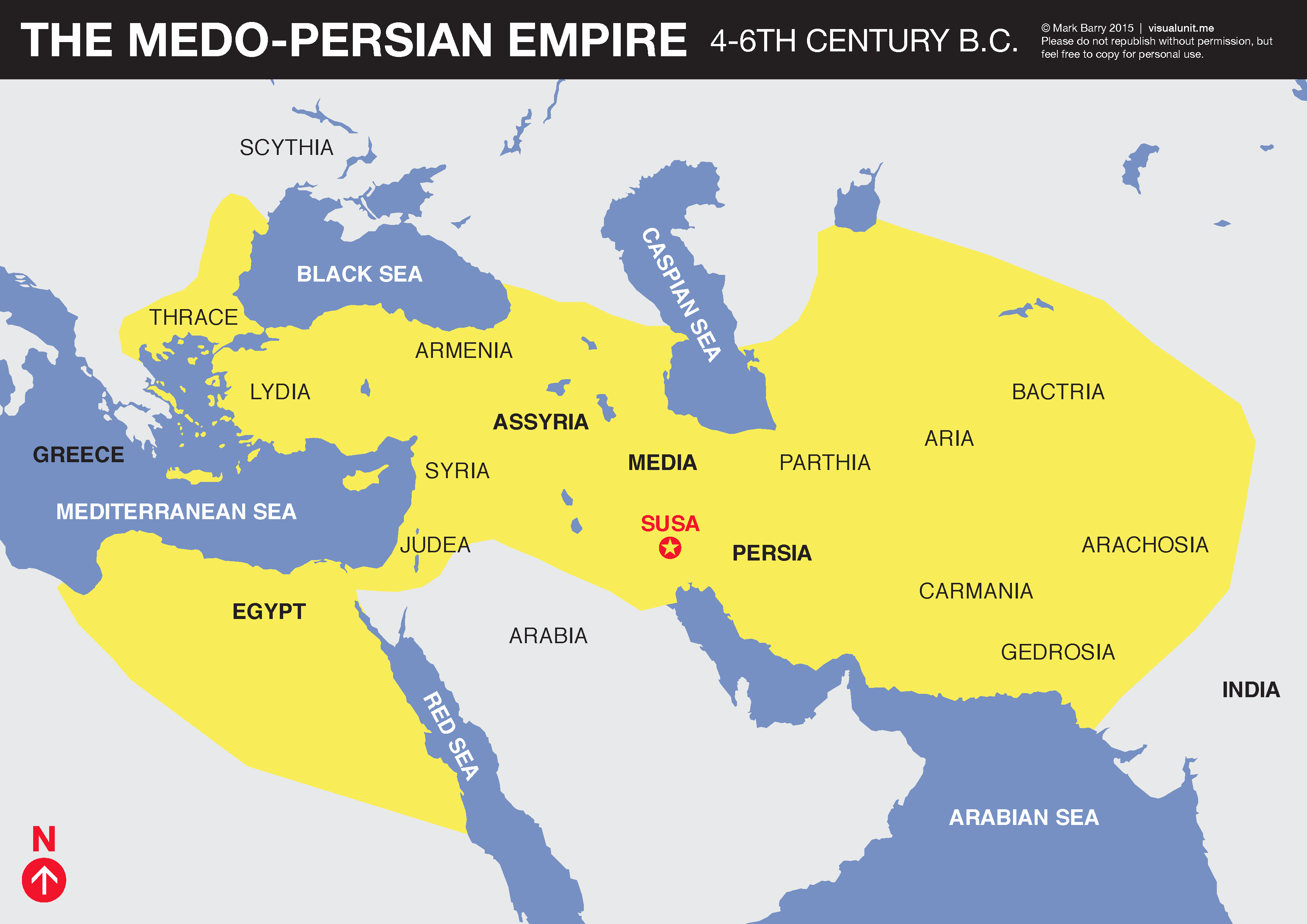
      Persia

      Medo-Persian Empire, 4th-6th Centuries BCE

      Chutzpah

      Yiddish: shameless audacity; guts

      Magnificat
      Luke 1:46-55 (TLV)
      Then Miriam said, “My soul magnifies Adonai, and my spirit greatly rejoices in God, my Savior. For He has looked with care upon the humble state of His maidservant. For behold, from now on all generations will call me blessed. For the Mighty One has done a great thing for me, and holy is His name. And His mercy is from generation to generation to the ones who fear Him. He has displayed power with His arm. He has scattered the proud in the thoughts of their hearts. He has brought down rulers from thrones and exalted humble ones. He has filled the hungry with good things and sent away the rich empty-handed. He has helped His servant Israel, remembering His mercy, just as He spoke to our fathers, to Abraham and to his seed forever.”
      Miriam

      Mary’s Hebrew name. Literally, “Rebellious”

      Ruakh / Ruach

      “Spirit”

      Ruakh HaKodesh, “Holy Spirit”

      Ruakh Elohim, “Spirit of God”

      Torah

      First 5 books of the Old Testament. The Law of Moses. The Pentateuch.

      Kohen

      Priest (Pronounced “KO-hayn”)

      Priests: Kohanim (Pronounced “ko-ha-NEEM”)

      Adonai

      Translated “LORD”. This word is typically used as a Hebrew substitute for the name of God given to Moses at the burning bush: YHVH (“I AM” sometimes rendered “Yahweh”)

      Yeshua

      Jesus’ Hebrew name, what his relatives and peers would have called him. Literally, “Salvation” or “God Saves”